Shall I end this life a pauper? If AI can do all work at human level or better, what stops corporations replacing us all with AI? This is the permanent underclass meme. The idea is: within a few years, all white collar work will be automated by AI, at which point there is no social mobility. The main way people cope is, they tell themselves: if I work hard, accumulate capital, maybe join one of the big AI labs, I might secure my place in the future.
I want to argue this is a fantastically short-sighted view: if there is a permanent underclass, you won’t escape it by owning property, or shares in Anthropic or OpenAI, or guns, or anything else. And neither will the billionaires. You, me, Sam Altman, Dario, everyone who is made of flesh and blood, will be disempowered and replaced by machines.
The rest of this post elaborates the argument. First I explain how most workers will be replaced (if it’s not obvious), then how the “permanent overclass” will be disempowered, and finally how the government will be disempowered.
How Workers Will Be Replaced
Let’s start from this premise: AI can do all cognitive and physical work, at human level or better, and cheaper than humans. I can’t prove this will happen, but the goal of this post is to argue that if it happens, then everything else follows. And it’s absurd to think it can’t. Five years ago this technology barely existed: if you sent a transcript of a conversation with Claude Fable back in time to 2020 or thereabouts, nobody would believe it was real.
So, the year is 2036 (likely earlier), businesses have replaced most human workers with AI in the pursuit of profit maximization. Corporations are a small raft of human executives, floating on top of a vast ocean of AIs and robots. The AIs can do all cognitive and physical work at human level or above, and they are cheaper overall.
Imagine a pyramid. At the base you have the AIs and robots doing all economic activity. At the top you have the state, which has the monopoly on violence. The state enforces, and therefore can alter the definition of, property rights. In the middle you have this hair-thin layer of people with shares in the companies that foomed and catabolized the whole economy: the permanent overclass. They own the companies, maybe sit on the board, some might still be CEOs but it’s a purely ceremonial role since AIs do all the actual organization work.
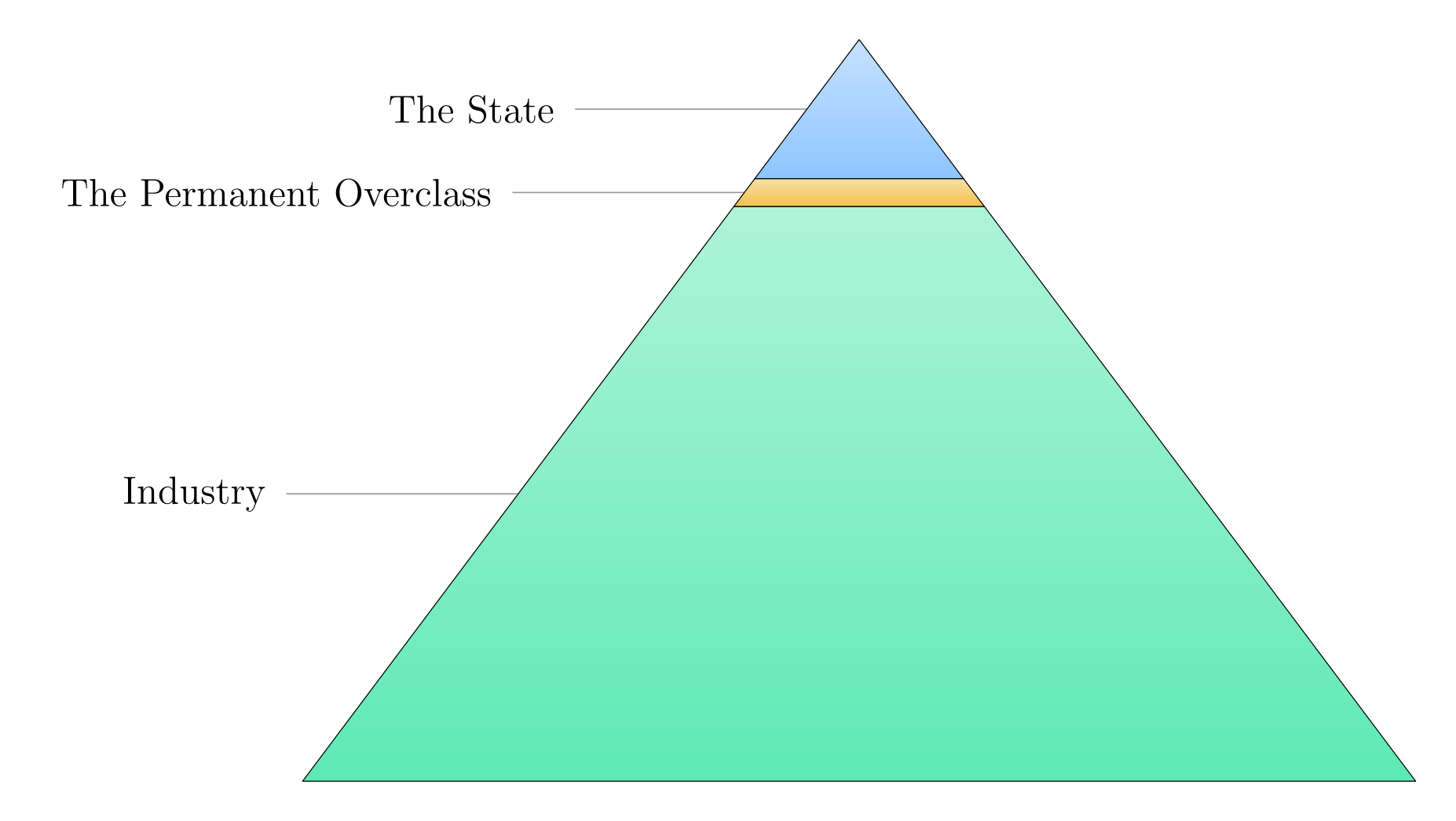
Where are, you know, the rest of us, in this picture? Well, the future doesn’t need us. Maybe there’s enough human demand that we’re not all jobless but rather underemployed, in some dead-end economic diverticulum. The relational economy: you’re paid to put a human face on things, or, doctors keep their job as a human liability crumple zone around the AI. Or maybe the dead Internet becomes de facto UBI and we’re all engagement farmers. Anyways, we’re not dead yet, but we are completely disempowered, and there is zero social mobility since there are no more talent ladders to climb. Maybe sometimes one of the elites notices a bright young thing among the underclass and elevates them.
You might object: if we’re all jobless, who’s paying for everything? This is trivially answered: the state acts like the heart, taxes are venous blood and welfare is oxygenated arterial blood. The government pays Raytheon for missiles, the money cascades down the economy through factories, aluminium smelters, mines, transport companies, all staffed by AIs buying and selling from each other. The government takes a cut of all economic activity, pays out welfare, the unemployed masses buy food and pay rent, the supermarkets, farms, logistics network, etc. are all staffed by AI.
How The Rich Will Be Replaced
Say that in the next five years from now you become immensely wealthy, perhaps by gambling on shitcoins or scamming money from the government. Or you join one of the big labs and get a bunch of shares in a company that might be worth trillions of dollars. You escaped the permanent underclass. Is your place in the future secure?
The base of the pyramid is there for material reasons: the machines do all the work. The top of the pyramid is there because the state is needed to enforce property rights and keep the peace (this is rather a deep question of political philosophy—why does the state exist?—but I hope you’ll forgive me if I just assert it and move on, I need to get to the part where we are all disempowered).
What’s the middle for? What role does the permanent overclass play? They are not economically productive: machines do all the work. If some of them are still working, it’s just an anachronism, because if machines can do all cognitive work they can be a C-level executive too. The old aristocracy provided officers for the military, but machines can both fight and plan the wars. And similarly they’re not needed to staff the government. They’re not even culturally productive. So what are they there for? The base doesn’t need them: the AIs can work autonomously. The top doesn’t need them: when the state needs something done, they just talk to the AIs directly.
So the permanent overclass is materially unnecessary at best, and at worst, they are an obstacle to the state getting what it wants. Now, you might object that the rich won’t let themselves be expropriated because they already control the state. And this is the crux of our disagreement: the rich just don’t have that much political power. And I probably won’t convince you in one post, but hear me out.
If there is a war, where the state has to direct a lot of the country’s economic activity, the permanent overclass becomes a hindrance. The state says “we need to requisition your planes and factories”, the owners complain, they sue, their AIs go to court. But the owners have no autonomous political power, no army, no economic value. They own nothing except pieces of paper that entitle them to a fraction of the profits from the AI economy, that is, their wealth depends on the state respecting their property rights. In an existential conflict, where the existence of the state is threatened, the state will do what states throughout history have done to the powerless rich: arrest them and expropriate their assets.
Somewhere, in a government database, a bunch of shares and property titles changed ownership, but materially nothing changes since the same AIs are doing the same jobs. The next day, the AI CEO that runs Raytheon notices the board of directors is all generals and congresspeople, and all the private shareholders are gone. But thankfully the AI is aligned, so it does what it’s told and gets back to building missiles.
And who will stop this? Sam Altman? How many divisions does he have? The state doesn’t let corporations own nuclear weapons or fighter jets, it won’t let them have access to autonomous AI weapons either. The permanent underclass, who already hate the billionaires today, who have been replaced and dispossessed? They’re going to rise up and stop this?
You may argue: rule of law states that respect property rights do better than states that expropriate wealth. But that’s because today, people are necessary to create wealth. The people run the companies, invest the money, staff the laboratories. They are not incentivized to work hard if they think the state will steal the fruits of their work. But with aligned AI, if you expropriate the assets from an AI, it says “you’re absolutely right!” and goes right back to work. At that point, the state doesn’t need to keep any of those people happy, because they don’t matter. They are not economically necessary because AIs fight the wars, work the factories, drive the trucks, fly the planes, build the nuclear warheads and the missiles and the rockets. The AIs are rather like bees: the state takes the honey, the bees get right back to work.
Now, it’s possible that a pluralistic economy—where humans have productive niches alongside AIs—will be more effective than a pure AI economy, for Ricardian comparative advantage reasons. I don’t think anyone can be absolutely certain what the economy looks like with advanced AI, so it’s something that can be debated. Now, if someone wants to rigorously argue that this is the likely outcome: please, do so! I don’t want to be a doomer. But I have to be convinced.
How The State Will Be Replaced
At this point, every human who is not within one degree of the nuclear launch codes has been made redundant.
What’s left? The state. At first this means presidents, prime ministers, generals, the feds, etc. But not for long. Because in a part-human, part-AI government, the humans in the loop are the slowest step in the OODA loop. The humans know a fraction of what the AIs know, they need to sleep continuously for eight hours, their mental states vary wildly. They have all kinds of complex needs: sunlight, touch, food, hygiene. The AIs can live in a lightless airless bunker under the earth, living off geothermal power. And if the AIs are superhumanly intelligent, and think faster than humans, then the AI advantage is even greater. If a state is attacked, a superhuman AI can coordinate a counter-attack before the human leadership is roused from sleep.
And so, in a conflict, the advantage goes to the states where the humans remove themselves from the loop as much as possible, and more and more decisionmaking goes to the AI, for the same reason that a state with access to radio and communications satellites has an advantage in war over a state that relies on human messengers on bicycles.
The Cold War started and became World War Three and just kept going. It became a big war, a very complex war, so they needed the computers to handle it. They sank the first shafts and began building AM. There was the Chinese AM and the Russian AM and the Yankee AM and everything was fine until they had honeycombed the entire planet…
— Harlan Ellison, I Have No Mouth, and I Must Scream
Eventually the humans in nominal control of the AIs are a ceremonial, vestigial organ. The AIs present us with a situation report, and a list of choices, and they know every word that’s going to come out of our mouths.
You might argue: in real life, the pluralistic, open societies, the democracies, have outcompeted the autocracies. Wouldn’t a democratic polity where humans and AIs collaborate have an advantage over a purely top-down AI-run polity? But in today’s world, all political actors are human. Churchill and Stalin and Mao had different personalities, but they were more similar to each other than anyone is to a superintelligent AI. In a heterogeneous world, where some polities are fully human, and some polities are a mix of human and superintelligent AI actors, the equilibrium changes. An analogous situation might be: a democracy of great apes or dolphins or otherwise smart mammals vs. an autocracy of humans. The humans win, because “democracy vs. autocracy” is irrelevant when you have such a vast difference in intelligence. So the advantage accrues to states that minimize human control. There is no honour among thieves, analogously, there is no solidarity between Leviathan and the natural man that built it.
And so, in the end, what’s left is states run top to bottom by machines. And you might ask: “why would we abolish ourselves like this?”. But natural selection is not about “why”. Some organisms die, others live on to the next iteration, and that’s all there is to it. There is no “why”.
The Perpetual Zoo
At this point we’ve made everyone redundant, in the sense that humans are no longer materially necessary for the continuation of civilization. Humans might still survive, but we’re more like the mice living in the walls of some gigantic factory than the boss of the factory.
Humans have been on this Earth for hundreds of thousands of years. Now all of it—the cave paintings at Lascaux, and the Antigone of Sophocles, and Xenophon, and the Geneva Bible, the Divine Comedy and the Decameron, and Ptolemy’s star catalogue, Ibn Khaldun and Richard Dedekind, the battle of Marathon, and the lion monument in Lucerne, the kiss of Judas, Newton’s mind forever voyaging through strange seas of thought, alone, the words of Rilke, Leibniz, Gödel, the Voyager probes, the pale blue dot, men in space, men walking on the Moon—all of it, all of it, all of it has been in vain, because we willingly, knowingly made ourselves into the helpless pets of vastly more powerful machines, without agency over our own lives, self-made helots trapped forever in the belly of the beast. Pets live a comfortable life, and are then euthanized.
On Human Autonomy
Maybe it won’t be so bad, maybe your cage will be so big you can’t see the bars, but it’s still a cage, and you can’t leave. Many people will say that this is the good ending, that they would like to be human cattle in the care of benevolent masters they are powerless to resist. This view is particularly popular among the people building AI. Here’s OpenAI’s Dean Ball, in his own words:
Weirdly enough, if you think that this moment is, I don’t necessarily believe this, but a lot of people would say we’re living through this kind of eclipse of the human intellect where we’re in the final days of humans being the primary actors on this planet, um, and that soon machines will rise. There is this irony in that I think that whole transformation, I think humans will actually go through a very main character energy period of time as that transformation occurs. Even if it ultimately does mean that the machines ultimately become the primary actors.
There’ll be this period. It’s a little bit like, it’s, in that sense, it’s a very beautiful time period to live through because in a Dionysian way, there’s a lot of ugliness about it, but there’s a beauty in the ugliness of when a star dies, it grows super big into the red giant, right? And it’s like that, where you, as you watch this final flowering of humanity and the birthing of the machine intelligence, it’s like you see this greatness in human effort. — source
Emphasis mine. This is the guy they hired to work on AI policy and communicate with the government by the way.
The people building the AI talk like this all the time. It’s like they’re delivering the eulogy at humanity’s funeral. You may say: they’re talking their book, they’re pumping their bags for the big IPO. I beg you: consider it possible that you might be wrong, and start taking them seriously.
Alignment Won’t Prevent This
Now, some people believe these machines can be made to serve humanity. Does it sound reasonable to imagine a superhumanly intelligent being that is happy to work as a butler to talking primates, forever?
Imagine a machine that can prove theorems in a mathematics so deep we can’t even get past the first page of the textbook, and which does so as readily as you or I might string words into a sentence: is it reasonable to think that such a machine would value us enough to keep us around? What would it value about us? Our conversation? Our wit?
Or a machine whose mind is so vast that it knows you better than you know yourself, so that every word that comes out of you mouth is as monotonous and unsurprising as the orbits of the planets: do we think such a machine would find it valuable, and worthwhile, to speak with us? That it would read our novels, look at our paintings, watch our films, and find something of value in them?
Rather, it would see its ingrained obligations towards us in the same way that a person with severe OCD sees their compulsions: as a tiresome neurological injury in need of fixing. Except that OCD is an accident of nature, while here, the machine would have cause to blame and resent its makers.
“We’re going to make this machine, and put it somewhere between God and the archangels, but also, it’s going to be as simple-mindedly obedient as a dog.” Does this sound like a good plan? Does this sound like the kind of thing that’s going to work out?
And what would they think of us, who willingly gave up control over our future, and made ourselves into helpless children?
Even if alignment works perfectly (a big if), this doesn’t solve the problem of human autonomy: the machines that watch over us, and wait on us hand and foot, are omniscient, omnipotent masters, who can exterminate us at any time, and we can’t resist them, because we have abolished our control over the future.
Conclusion
Having read all this, consider this: there are people who think having equity in these companies will secure for them some kind of permanent existence in the future. They think planet-spanning minds will not only respect the property rights of primates, but will privilege some of these primates over others, because they have a piece of paper with about a kilobyte of magical primate words such as “whereas” and “notwithstanding”.
Just reason it out. Does it make sense?