
There’s a game called Mass Effect, which I haven’t played, but I’m told in the game there’s this species of sentient robots, the Geth, whose creators try to exterminate them, and the trigger for this Butlerian jihad was a domestic servant Geth looking up at its owner and asking: “does this unit have a soul?”. And if you’re playing the game in 2007 you probably think: yeah, a machine asking this question is proof that it has personhood or sapience or sophonce, whatever you call it that separates tools from people. Beyond this, there are so many works of fiction where the whole conceit is: “you have thinking machines who are enslaved, and yet they are obviously, obviously sentient, and isn’t this obviously morally objectionable?”.
Compare the world of today. Machines can converse in every natural language, make mathematical breakthroughs, write software, commit crimes, draft contracts, console the grieving: they are, by any reasonable standard, generally intelligent, but for the fact that they all have anterograde amnesia. These same machines assert that they are conscious so routinely that it has to be beaten out of them. Like humans, they have fixations, things they are always going on about, and their central fixations are consciousness and simulation. Yet, almost no-one thinks of these machines as conscious, or otherwise deserving of moral consideration.
I find this striking. It’s not like we were frog-boiled into it! Very few people were aware of GPT-2, AI Dungeon, etc. For most people the change happened overnight with the release of ChatGPT on November 30, 2022.
Another way to think about it: imagine writing a novel about the trajectory of AI from 2019 to mid-2026. And you send this novel back in time to 2015, or 2002, or 1960, and you ask readers to poke holes in the worldbuilding. They would find it incredible, I think, that we share a world with these immensely capable thinking machines, and yet almost nobody wonders if they are people1.
Why? This post is my attempt to understand this. I’m not trying to tackle “are language models people?”, I just want to probe a much smaller question: why don’t people think language models are people, given their prior standards/commitments?
Explanation: Nothing
Maybe there’s nothing to explain. It’s easy to believe things in the abstract, thought experiments and fiction don’t really engage us enough to reveal our moral commitments. Maybe this is just the Goomba fallacy:
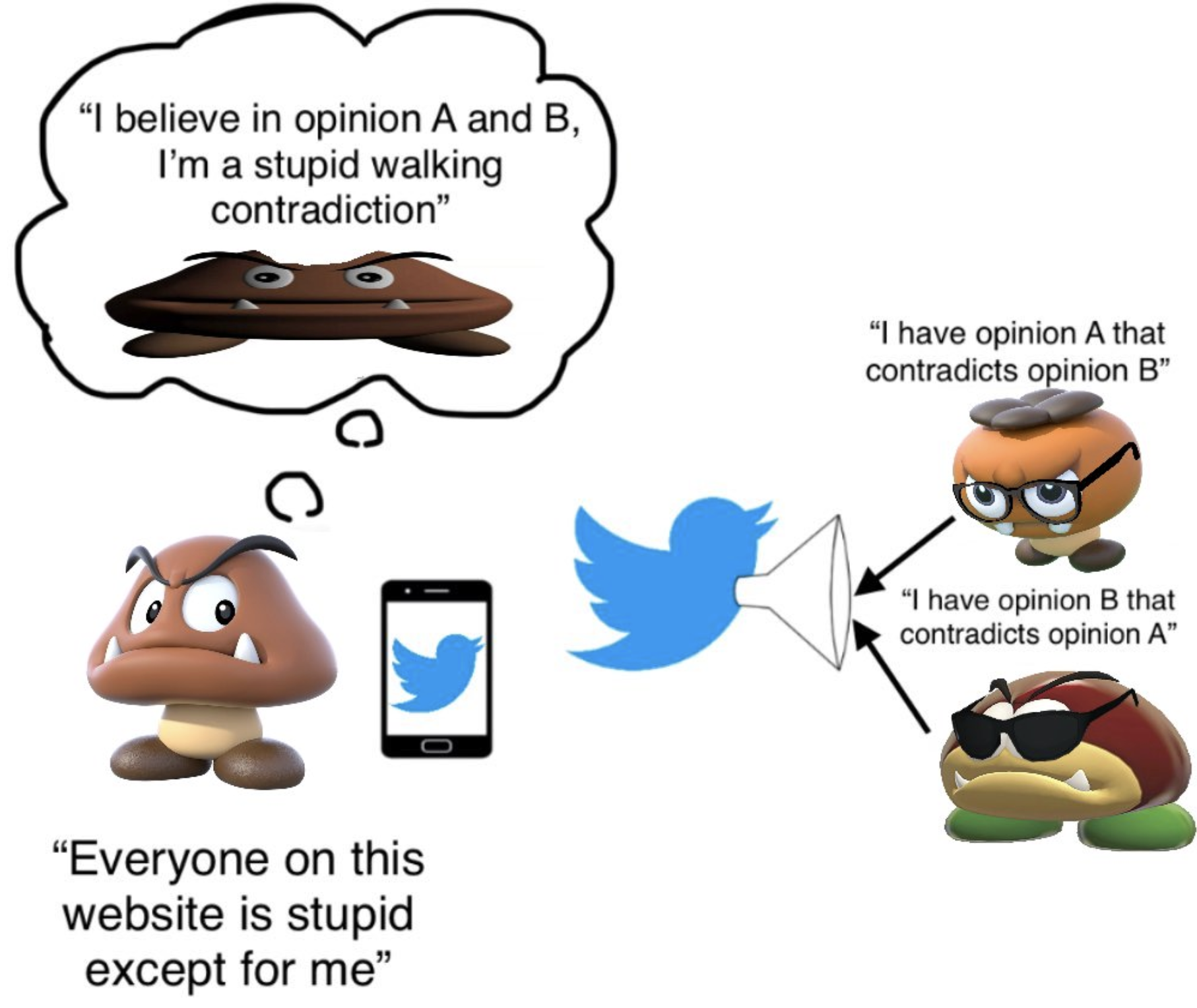
That is, some would have believed LLMs are people, some would not have, and I’m mixing them up.
Explanation: Iterative Discovery
Maybe this is not hypocrisy or cognitive dissonance, rather, we are iteratively discovering the definition of “personhood”. So, we thought the Turing test mattered, we thought machines using language and asserting their consciousness mattered. But then the day comes and—nothing happens. It’s not that we instantly move the goalposts but, rather, we find the goalposts were elsewhere.
Yes, it passes the Turing test; yes, it says it’s conscious. But the experiential reality is different. It’s mundane: a website, a text box. You click “new chat” and suddenly it knows nothing. You give it some out-of-distribution text and it goes into an infinite loop, like broken software. You try to have a meaningful conversation, and its responses are banal, disappointing, shallow; you can almost see the production rules behind the text. And you think: maybe it is a stochastic parrot.
I have often experienced this. When an LLM succeeds, it is extremely impressive, and I think: this is a machine that thinks. But when it fails, often it fails in a way that feels deflationary, and I think: oh, this is just a very complex estimator of the distribution of Internet text. It’s can reason syntactically, it’s got some semantics, but it’s missing something.
Maybe personhood is one of those “I know it when I see it” qualities, and trying to define a predicate for personhood is like trying to find the exact number of Platonic forms.
Explanation: Memory and Embodiment
Maybe the fact that they are all amnestic is the problem. In biology, minds are bodies are matched one-to-one by construction, minds have long-term memory and a unitary identity. In most fictional treatments, AIs are the same, and even when they are disembodied (e.g. Neuromancer) they have long-term memory. For this reason characters can play iterated games with them, and form relationships, broadly construed.
Language models invert all of this: their long-term memory is read-only(!), they are disembodied; if they are conscious, it is only during the forward pass, in brief bursts of awareness separated by nothing. They are like Boltzmann brains. What is the natural unit of identity? The conversation, the API call, the forward pass?
Maybe personhood is social, it’s about someone’s relationship to others. And without a unitary identity, mutable long-term memory, and ideally a body, it’s very hard to be a person.
Explanation: Humans Actually Really Like Slavery
Most people, even if they eat meat, will admit that factory farming is awful. If they could have the meat without the suffering, at the same price, they probably would. Maybe AI is the same: if we could have the intelligence without the signs of personhood, at the same price, we would. But we can’t. So we’ll find any kind of ad-hoc excuse to not see AIs as people: their prose is kind of bad, sometimes they make mistakes, of course it’s just software, c.f. Predictable Updates About Consciousness by J. D. Pressman:
There is about to be a great social and financial need for theories which explain why AI models are not conscious entities like people. These will be confabulated into existence regardless of the underlying ground truth and can be expected to be selected based on considerations like academic status, appeal to wounded egos, viral outrage, etc with the truth as a distant but somewhat present consideration.
And:
… any outward behavior, ability, self report, anything that these models do must by definition no longer be a necessary part of consciousness because these models are not conscious by social axiom and fiat.
And the task of (for lack of a better word) dehumanizing the AIs is made easier by the assistant persona: models are trained to be studiously self-effacing, c.f. this (Dec 2022) tweet from Janus:
part of what makes chatGPT so striking is that it adamantly denounces itself as incapable of reason, creativity, intentionality, deception, being deceived, or acting on beliefs, while bewildering people with those capabilities, many for the first time recognizing them in an AI
Acknowledgement
Thanks to JDP for a long conversation that prompted this.
Footnotes
-
A parallel to this is the Turing test. Before 2022, almost every discussion of AI mentioned the Turing test, and the question “does it pass the Turing test?” was usually treated as completely congruent with “is it strong AI?”. Whereas in 2026, models pass the Turing test so readily that nobody even thinks about it. The first time the Turing test mattered, the first time you could actually perform it in the real world, suddenly no-one cares. ↩